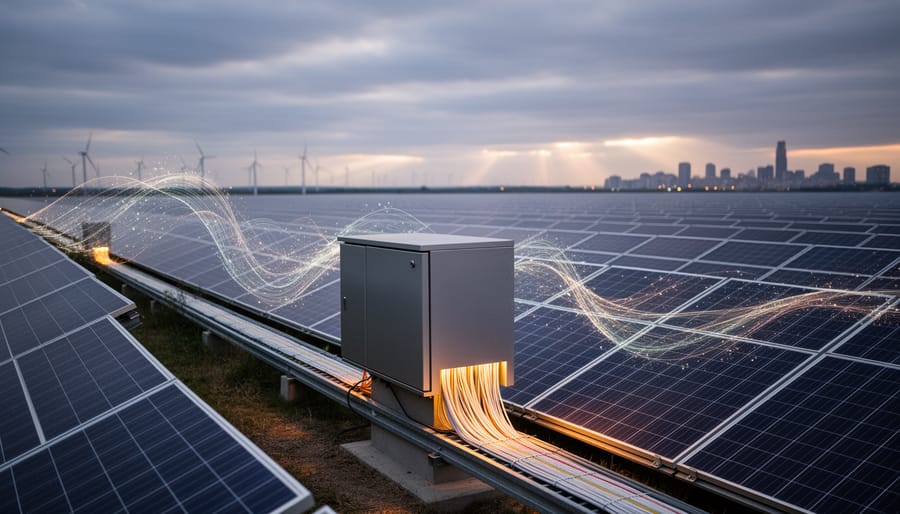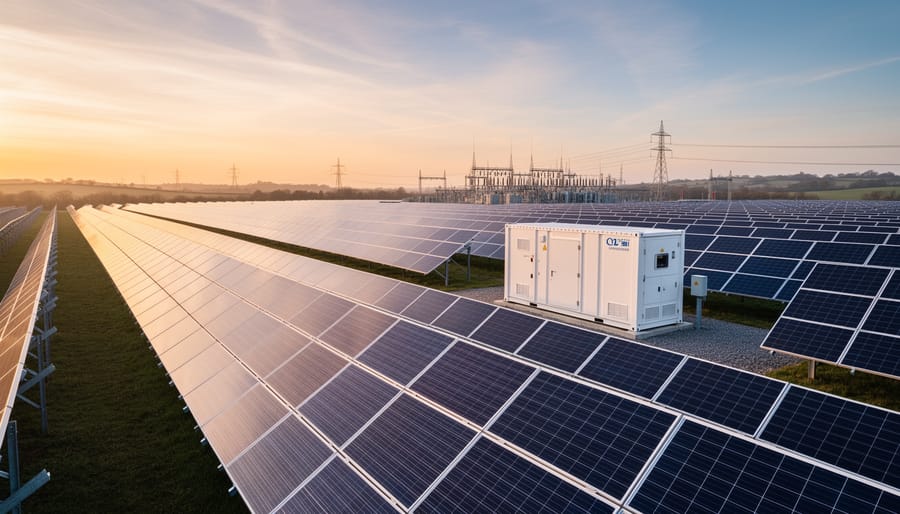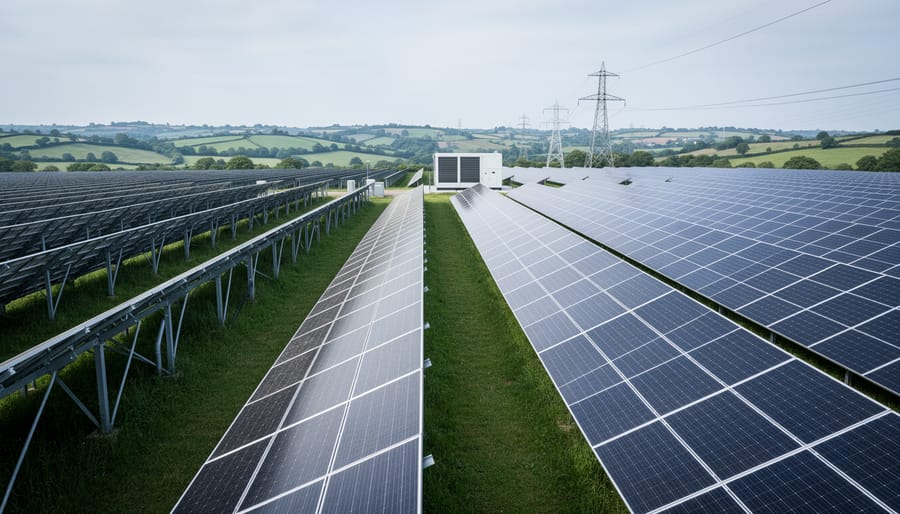
Utility-scale solar refers to large-scale photovoltaic installations, typically 5 megawatts or larger, that generate electricity for direct sale to the grid rather than for on-site consumption. These industrial-scale solar farms represent the fastest-growing segment of renewable energy infrastructure worldwide, now delivering some of the lowest-cost electricity available in most markets and playing a central role in the transition away from fossil fuels.
Unlike residential rooftop systems measured in kilowatts or commercial installations serving individual businesses, utility-scale projects span hundreds of acres and can power tens of thousands of homes. The economics are fundamentally different. Utility-scale developments benefit from economies of scale that drive down the cost per watt, streamlined permitting for dedicated energy sites, and direct access to wholesale electricity markets. A single 100-megawatt solar farm can generate enough electricity annually to offset hundreds of thousands of tons of carbon emissions.
The technology itself mirrors smaller systems but at massive scale: tens of thousands of solar panels mounted on tracking systems that follow the sun, paired increasingly with battery storage to provide power after sunset. What sets utility-scale apart is the commercial and regulatory landscape. Developers must navigate complex land acquisition, grid interconnection agreements, power purchase contracts with utilities, and environmental reviews that can take years to complete.
This convergence of proven technology, compelling economics, and urgent climate goals has made utility-scale solar the backbone of clean energy deployment globally, fundamentally reshaping how and where electricity gets generated.
What Utility Scale Solar Actually Means
Utility scale solar refers to photovoltaic installations large enough to supply electricity directly to the transmission or distribution grid, typically serving thousands of homes or businesses rather than a single property. These projects cross a meaningful threshold, both in physical size and operational complexity, that separates them from rooftop arrays or small commercial setups.
The most widely recognized benchmark is 5 megawatts (MW) of generating capacity, though industry definitions vary slightly by region. Projects below this threshold usually fall into the commercial or community solar category, while utility-scale installations commonly range from 5 MW up to several hundred megawatts at a single site. The UK’s largest solar farms exceed 50 MW, covering hundreds of acres with tens of thousands of panels arranged in carefully engineered arrays.
- Utility-scale
- Solar installations designed to generate electricity for wholesale power markets rather than on-site consumption, typically exceeding 5 MW in capacity.
- MW capacity
- Megawatts of generating capacity, the standard measure for utility-scale projects; one MW powers roughly 200-300 UK homes under average conditions.
- Grid-tied systems
- Installations connected to the high-voltage transmission or distribution network, delivering power into the wholesale electricity market.
- Power purchase agreements (PPAs)
- Long-term contracts between solar developers and energy buyers that guarantee revenue for electricity generation, typically spanning 15-25 years.
What truly distinguishes utility-scale solar is the grid connection. These projects feed power into high-voltage transmission lines or substations, requiring complex interconnection agreements with network operators. Residential solar offsets household consumption, exporting occasional surplus; utility-scale exists solely to generate wholesale electricity.
The infrastructure differs markedly too. Utility projects deploy specialized mounting systems designed for extreme weather resilience, centralized inverters handling massive power flows, and sophisticated monitoring systems tracking thousands of panels simultaneously. They operate under different regulatory frameworks, planning requirements, and financial structures than smaller installations.
Land requirements create another clear divider. A 5 MW project needs roughly 12-15 acres, while larger installations can span entire working farms. This scale demands environmental impact assessments, agricultural land reviews, and community consultations that rooftop solar never encounters.
The Economics Driving Utility Scale Solar Forward
The financial case for utility scale solar has become increasingly compelling over the past decade, driven by fundamental shifts in technology costs and market dynamics. What once required substantial subsidies to compete now often represents the cheapest form of new electricity generation available to grid operators.
The primary economic advantage lies in sheer scale. A 50 MW utility installation can achieve per-watt installation costs 40-60% lower than a 5 kW residential system. This advantage stems from bulk purchasing of equipment, streamlined permitting processes, reduced labor costs per watt, and efficient deployment of specialized machinery. When developers order thousands of panels instead of dozens, suppliers offer dramatic volume discounts. Ground-mounted systems also avoid the complexity and safety requirements of rooftop work, further driving down installation expenses.
Installation costs have plummeted across the board. Benchmark figures show utility solar falling from over $4 per watt in 2010 to below $1 per watt in many markets by 2024, with further reductions expected. Module prices now represent less than 20% of total project costs in many cases, as balance-of-system components and soft costs have also declined through industry maturation and competition.
This cost reduction translates directly into competitive energy pricing. Utility scale solar projects routinely deliver electricity below £40 per MWh in competitive auctions, undercutting new gas generation without requiring carbon pricing to be economically viable. The fuel cost remains permanently zero, providing price stability that fossil alternatives cannot match.
Revenue certainty comes through power purchase agreements, which lock in fixed electricity prices for 15-25 years. These PPAs allow developers to secure project financing by demonstrating predictable cash flows to lenders. Banks now view utility solar as mature infrastructure with understood risk profiles, resulting in favorable lending terms that further improve project economics.
Government support mechanisms still play a role in many markets, though increasingly as market enablers rather than survival subsidies. Contracts for Difference schemes in the UK, for example, provide revenue stability that encourages development while ensuring consumers benefit when market prices rise above strike prices. Tax incentives and accelerated depreciation rules in various jurisdictions improve project returns without fundamentally changing the underlying economics.
The result is an asset class that delivers stable, long-term returns while generating clean electricity at competitive prices. Institutional investors now view utility solar as infrastructure investment comparable to toll roads or regulated utilities, with pension funds and insurance companies allocating billions to solar portfolios.
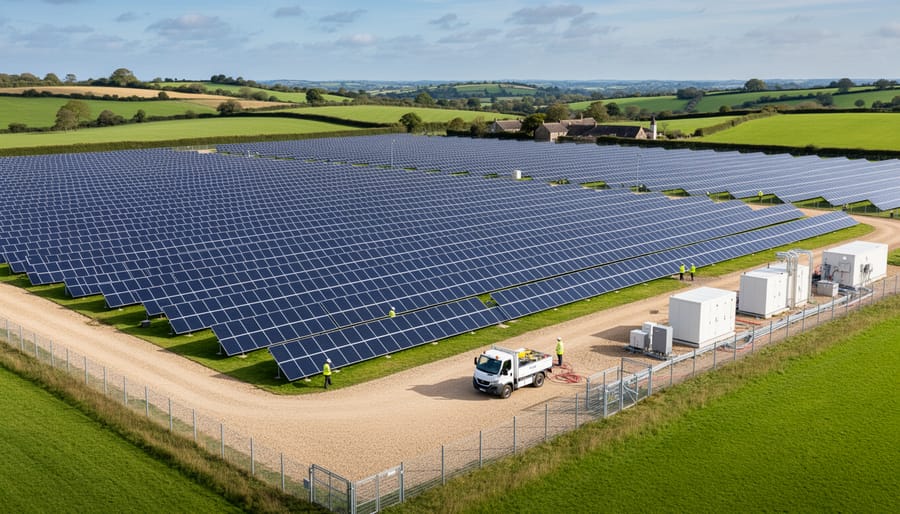
Technology Innovations Powering Large-Scale Solar
Advanced Panel Technology at Scale
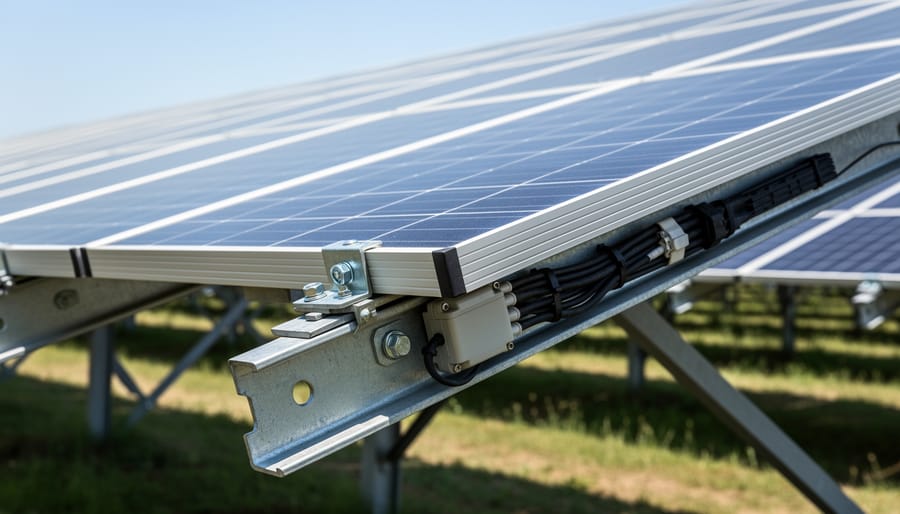
Utility-scale installations demand panels engineered for maximum output and durability under industrial conditions. High-efficiency monocrystalline modules, often exceeding 22% conversion rates, have become the standard, delivering more electricity per square metre and reducing land requirements for multi-megawatt arrays.
Bifacial panels capture reflected light from the ground on their rear surfaces, boosting energy yields by 10-30% depending on site conditions. Developers increasingly pair these with white reflective ground cover or elevated mounting structures to maximize rear-side gains. Large-format panels, typically 600W or above, reduce installation time and balance-of-system costs by covering more area with fewer units and mounting points.
These advanced designs also incorporate hardened glass and reinforced frames to withstand decades of weathering. At utility solar scale, where projects span 50 hectares or more, minor efficiency improvements and durability gains translate into millions in additional revenue over a project’s 25-30 year lifespan. Developers now routinely model panel degradation rates below 0.5% annually, ensuring predictable long-term performance that underpins financing models and power purchase agreements critical to project viability.
Smart Grid Integration and Storage
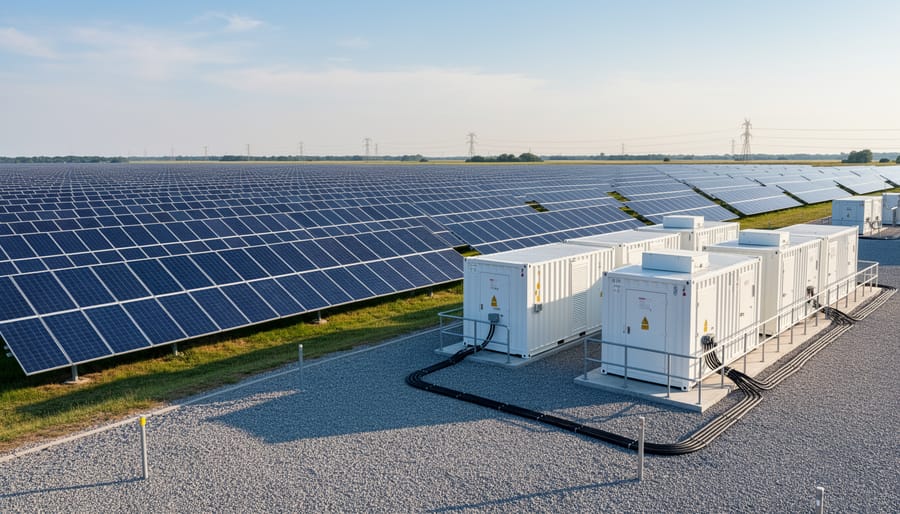
Grid-tied utility scale solar installations now routinely integrate battery storage to address intermittency and enhance grid stability. Large-scale lithium-ion systems, typically 50 to 200 MW in capacity, store excess midday generation for dispatch during evening peak demand or when cloud cover reduces output. This pairing transforms solar from a variable resource into a dispatchable asset, allowing operators to provide firm capacity commitments to grid managers.
Advanced energy management systems coordinate generation, storage, and transmission in real time. Predictive algorithms forecast solar production using weather data and satellite imagery, then optimize battery charge-discharge cycles to maximize revenue while maintaining grid services. Many projects participate in frequency response markets, where battery systems react within milliseconds to grid fluctuations, a service that traditional generation cannot match at this speed.
Smart inverters provide reactive power support and voltage regulation, functions once performed exclusively by fossil-fuel plants. Grid-tied PV with storage configurations enable operators to smooth output ramps, defer transmission upgrades, and provide black-start capability after outages. Some installations deploy modular storage architectures that allow capacity expansion as grid needs evolve.
Co-location delivers economic advantages, too. Sharing a single grid connection point reduces infrastructure costs, while combined facilities can stack revenue streams from energy arbitrage, capacity payments, and ancillary services. As battery costs decline and grid codes evolve to value flexibility, storage integration is becoming standard rather than optional for new utility scale solar projects.
Planning and Development Challenges
Developing utility-scale solar projects requires navigating a complex web of practical, regulatory, and logistical challenges that can easily extend timelines from initial concept to grid connection by three to five years. While the technology itself has matured significantly, the infrastructure and approval systems surrounding these large installations often lag behind the urgency of the energy transition.
Land acquisition represents one of the earliest and most persistent hurdles. Utility-scale projects typically require 4-6 acres per megawatt of capacity, meaning a 50 MW installation needs roughly 250 acres of suitable terrain. Developers must secure land through purchase or long-term lease agreements, competing with agricultural interests, conservation priorities, and other industrial uses. In densely populated regions, finding contiguous parcels with appropriate solar exposure, minimal shading, and acceptable topography becomes increasingly difficult. The financial stakes are substantial: committing to land before securing planning permission carries significant risk, yet waiting to secure land until after approval may mean losing the site to competing interests.
Grid connection capacity presents perhaps the most formidable technical barrier. Many regions face grid connection queues stretching years into the future, with developers waiting for network operators to upgrade substations and transmission infrastructure. Connection studies alone can take 12-18 months, and the costs of grid reinforcement sometimes fall partially on the project developer. In some UK regions, queue positions number in the hundreds, and projects regularly face unexpected delays when earlier projects in the queue require more extensive grid work than initially assessed.
Environmental assessments add further complexity and cost. Developers must conduct ecological surveys across multiple seasons to identify protected species, assess visual impact on landscapes and heritage sites, evaluate flood risk, and demonstrate minimal harm to local ecosystems. These studies are non-negotiable but time-consuming, and discovering protected newt populations or roosting birds can necessitate costly mitigation measures or site redesigns.
Community engagement, while essential for social license, introduces unpredictability. Local opposition can stem from aesthetic concerns, perceived property value impacts, agricultural land loss, or simply change resistance. Developers who approach communities as partners rather than obstacles, offering shared ownership models, community benefit funds, or co-located agricultural activities, generally fare better through the planning process, but meaningful engagement requires time and resources with no guaranteed outcome.
The UK’s Utility Solar Landscape
The United Kingdom has emerged as a significant player in utility-scale solar development, with operational capacity reaching approximately 7.5 gigawatts by early 2026. This represents a substantial evolution from the sector’s early days, when feed-in tariffs primarily drove smaller installations. Today’s landscape features projects routinely exceeding 50 MW, with several 100+ MW developments advancing through planning stages across southern and eastern England.
Regional deployment patterns reveal clear geographic concentration, driven by both solar resource availability and grid infrastructure. East Anglia, the South West, and parts of Yorkshire host the densest clusters of utility-scale installations, benefiting from higher irradiance levels and existing transmission capacity. However, grid connection constraints in prime solar regions have created bottlenecks, pushing developers to explore sites in areas with available capacity but potentially lower solar yields.
The policy framework shaping development has shifted considerably. The Contracts for Difference (CfD) mechanism now provides the primary revenue certainty for large projects, with recent allocation rounds seeing utility solar compete favourably against other technologies. Planning reforms introduced in 2025 designated solar projects above 50 MW as Nationally Significant Infrastructure Projects, streamlining consent processes but adding complexity to application requirements.
The project pipeline suggests accelerating deployment, with over 15 GW of utility-scale capacity at various planning stages. Discussions at the Utility Solar Summit underscored both the sector’s momentum and persistent challenges around grid connections, with developers reporting connection queue timescales extending beyond five years for some regions. This queue represents perhaps the single greatest constraint on translating planning consents into operational capacity, despite strong policy support and improving project economics across Britain’s solar utility scale sector.
Environmental and Community Considerations
Utility-scale solar projects occupy significant land areas, typically hundreds of acres, making land use the most visible environmental consideration. Developers must balance renewable energy goals with protecting agricultural land, wildlife habitats, and landscape character. In the UK, planning authorities scrutinize site selection carefully, often prioritizing brownfield sites or lower-grade agricultural land to minimize conflict with food production.
Biodiversity impacts vary substantially depending on site management. Well-designed installations can actually enhance local ecosystems compared to intensive farming. Planting native wildflowers between panel rows creates pollinator habitats, while careful grazing by sheep maintains vegetation without chemicals. Several UK projects now integrate biodiversity net gain strategies, installing hedgerows, creating wildlife corridors, and preserving field margins to offset any habitat loss.
Agrivoltaics, combining solar generation with crop or livestock production, addresses land use concerns directly. Elevated panels allow grazing underneath, while shade-tolerant crops can grow between rows. This dual-use approach maintains agricultural productivity while generating clean energy, though it requires careful design to balance both functions. Early UK trials with sheep grazing have proven particularly successful, providing ongoing farm income alongside energy revenue.
Community engagement often determines project success or failure. Nearby residents worry about visual impact, potential property value effects, and construction disruption. Forward-thinking developers address these concerns through comprehensive consultation, landscape screening with native hedging, community benefit funds, and sometimes local investment opportunities. Clear communication about temporary construction impacts versus long-term benefits helps build acceptance.
The most contentious projects typically fail to engage communities early or adequately address local priorities. Successful installations demonstrate that utility-scale solar can coexist with rural communities when developers prioritize transparency, mitigate genuine impacts, and share benefits fairly rather than simply imposing infrastructure.
Utility-scale solar stands at a pivotal moment. The projects transforming Britain’s energy landscape aren’t just impressive in scale, they represent a fundamental shift in how nations generate and consume electricity. These installations have moved from experimental ventures to essential infrastructure, delivering clean energy at costs that now compete directly with fossil fuels.
The path forward isn’t without complexity. Grid capacity constraints, land-use debates, and planning hurdles remain genuine obstacles that require thoughtful navigation. Yet the momentum is unmistakable. Falling technology costs, advancing storage solutions, and increasingly urgent climate commitments are accelerating deployment across the UK and globally.
What utility scale solar projects demonstrate most clearly is that renewable energy transitions aren’t theoretical exercises, they’re happening now, at gigawatt scale. The sector has matured beyond early-stage innovation into sophisticated infrastructure delivery, combining engineering expertise with financial discipline and community engagement.
The next decade will determine whether this momentum translates into the wholesale energy transformation climate targets demand. Based on current trajectories, technological capabilities, and growing political will, utility-scale solar looks positioned to claim an even larger role in powering modern economies sustainably.