Solar United Kingdom represents a pivotal industry network and advocacy organization driving the expansion of utility-scale solar projects across the UK, bringing together developers, investors, policymakers, and technology providers at flagship events like the Utility Solar Summit. As the nation accelerates its renewable energy transition, this coalition has emerged as a central force connecting the commercial solar sector with government initiatives and grid infrastructure planning.
The organization’s prominence at industry summits reflects a broader transformation underway in Britain’s energy landscape. With the UK targeting substantial gigawatt-scale solar capacity additions in the coming years, Solar United Kingdom serves as both a knowledge hub and collaborative platform. It addresses critical challenges facing utility solar development, from planning permission bottlenecks to grid connection queues, while championing innovations in bifacial panel technology, battery storage integration, and agrivoltaic systems that combine farming with energy generation.
At the Utility Solar Summit and similar gatherings, Solar United Kingdom facilitates high-level dialogue between project developers managing multi-hundred-megawatt installations and the financial institutions backing them. The network also bridges the gap between commercial interests and regulatory frameworks, particularly as the UK government refines subsidy mechanisms and market structures to support utility-scale renewable deployment.
Understanding Solar United Kingdom’s role provides essential context for anyone tracking the UK’s solar industry evolution. The organization doesn’t just convene stakeholders; it actively shapes the conversation around how large-scale solar will power Britain’s grid, influence land use policy, and contribute to net-zero commitments. For industry professionals and solar advocates globally, its activities offer valuable insights into how mature markets are scaling solar beyond rooftop installations into the utility domain that will define the next decade of renewable growth.
What Is Solar United Kingdom?
Solar United Kingdom operates as a collaborative industry platform that brings together developers, investors, technology providers, and policymakers focused on accelerating utility-scale solar deployment across Britain. Unlike traditional trade associations, it functions primarily as a knowledge-sharing network and strategic alliance, positioning itself at the intersection of commercial development and policy advocacy.
The organization’s core mission centers on removing barriers to large-scale solar projects while establishing best practices that make the UK a more attractive market for solar investment. This involves coordinating technical standards, sharing grid connection intelligence, and creating forums where stakeholders can address common challenges collectively rather than in isolation.
Its membership structure includes both multinational energy corporations and domestic independent power producers, alongside engineering firms, equipment manufacturers, and financial institutions active in renewable energy. This diverse stakeholder base gives Solar United Kingdom credibility across the value chain, from project conception through construction and operation. The platform also maintains working relationships with government departments, network operators, and local planning authorities, though it remains industry-led rather than a quasi-governmental body.
What distinguishes Solar United Kingdom from broader renewable energy organizations is its exclusive focus on utility-scale installations, projects typically exceeding 50 megawatts that connect directly to transmission networks. This specialization allows the group to drill into technical challenges specific to large solar farms, such as grid stability contributions, land-use planning at scale, and hybrid system configurations that pair solar with battery storage.
The organization emerged during a period of renewed interest in solar as subsidy-free economics became viable and the UK set ambitious net-zero targets. Rather than duplicating existing industry bodies, Solar United Kingdom carved out a niche as the convening force specifically for utility solar’s unique needs in the British market.
The Growth of Utility-Scale Solar in the UK
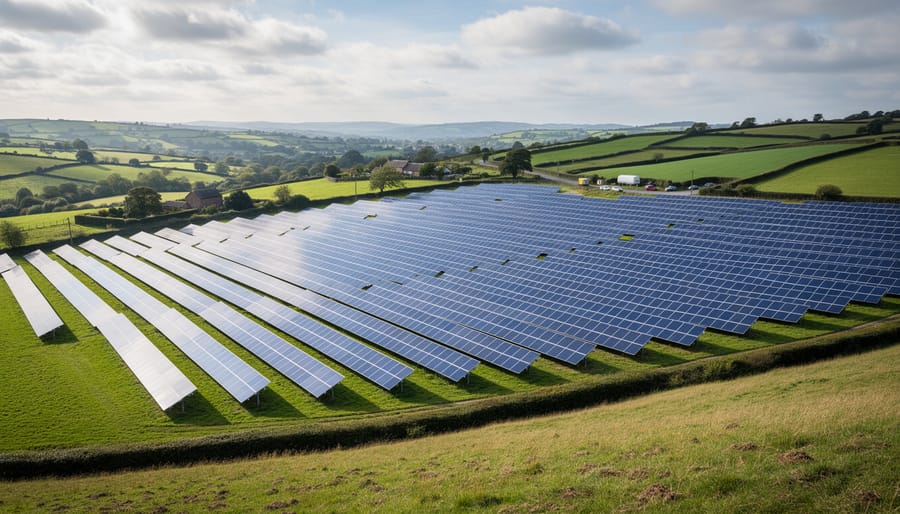
Britain’s utility-scale solar sector has undergone a dramatic transformation since 2020, evolving from a subsidy-dependent nascent industry into a cornerstone of national energy policy. The country now hosts over 14 gigawatts of total solar capacity, with utility-scale installations, those exceeding 5 megawatts, accounting for roughly 40% of that figure. This shift reflects both maturing project economics and governmental recognition that large-scale solar farms deliver energy at price points competitive with conventional generation.
Investment in utility-scale projects in Britain reached £2.8 billion in 2025 alone, more than double the 2022 figure. Developers cite falling panel costs, streamlined grid connection processes in select regions, and corporate demand for renewable power purchase agreements as primary catalysts. Official solar PV cost and capacity data shows the levelized cost of utility-scale solar dropped 35% between 2020 and 2025, making new projects viable without direct subsidies in high-irradiance southern counties.
| Year | Installed Utility Capacity (GW) | Annual Additions (GW) | 2030 Target (GW) |
|---|---|---|---|
| 2020 | 3.2 | 0.4 | |
| 2023 | 4.9 | 0.9 | |
| 2025 | 6.1 | 1.2 | |
| 2030 (projected) | 12-15 |
Policy drivers underpinning this expansion include the government’s net-zero-by-2050 commitment, which assigns solar a substantial role in decarbonizing the grid, and reforms to planning guidance that designate certain low-grade agricultural land as suitable for solar development. The British Energy Security Strategy, updated in 2024, explicitly targets 30 gigawatts of total solar capacity by 2030, a goal requiring sustained utility-scale deployment at roughly 1.5 gigawatts per year.
Yet growth remains uneven. Scotland and Wales lag England in utility installations due to lower irradiance and grid infrastructure constraints, while planning opposition persists in historically agricultural regions. Developers increasingly pursue hybrid projects pairing solar with battery storage or co-located wind to maximize site value and revenue stability, a trend that shapes both financing models and grid integration strategies moving forward.
Solar United Kingdom’s Role at the Utility Solar Summit
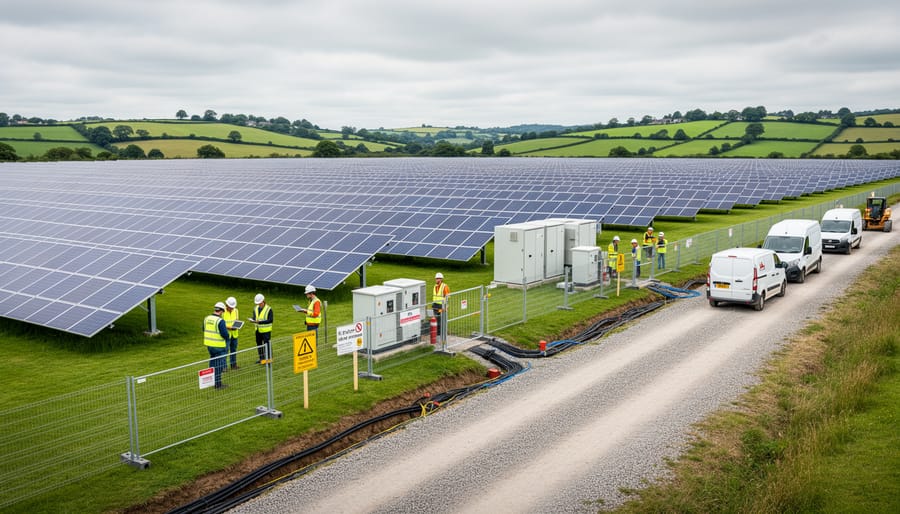
At the 2026 Utility Solar Summit in UK, Solar United Kingdom emerged not merely as a participant but as a convening force for stakeholders across the value chain. The organization orchestrated panel discussions bringing together developers, grid operators, financiers, and policymakers to address bottlenecks hindering large-scale project deployment. Rather than presenting a singular corporate agenda, Solar United Kingdom positioned itself as a platform for collective problem-solving, facilitating conversations around offtake agreements, planning reform, and grid access that individual companies struggle to advance alone.
The summit provided Solar United Kingdom with a strategic venue to showcase three pilot initiatives developed through member collaboration. First, a standardized pre-application framework for projects exceeding 50MW, designed to reduce planning timeframes by establishing common environmental assessment protocols. Second, a grid connection cost-sharing model that pools resources from multiple developers to fund necessary substation upgrades in high-potential regions. Third, a community benefit template that helps developers structure local investment schemes consistently, reducing negotiation friction with councils.
Solar United Kingdom’s messaging at the summit centered on de-risking utility solar deployment through coordinated action rather than competitive silos. Representatives presented data showing that fragmented approaches to grid applications have led to queue congestion, with some projects waiting five years for connection offers. Their proposed regional coordination mechanism would see developers commit to phased connection dates, allowing network operators to plan reinforcement work more efficiently and unlock capacity for multiple sites simultaneously.
The organization also used the summit platform to advocate for policy refinements, specifically around Contract for Difference allocation rounds. Solar United Kingdom proposed auction design adjustments that would account for regional grid constraints, potentially allowing higher strike prices in areas where network costs currently make projects unviable. This wasn’t abstract advocacy, the organization presented modeling showing how targeted strike price adjustments could unlock 2GW of additional capacity in Scotland and Wales by 2028.
Throughout the summit, Solar United Kingdom coordinated side meetings between developers and institutional investors, addressing financing gaps for subsidy-free projects. These closed-door sessions yielded a draft term sheet for standardized corporate Power Purchase Agreements, potentially reducing legal costs and negotiation timelines that currently delay financial close. The summit functioned as both showcase and workshop for an organization building infrastructure around collaborative advancement rather than individual project promotion.
Key Innovations Championed by Solar United Kingdom
Grid Integration and Infrastructure Solutions
Grid connection represents one of the most pressing bottlenecks facing utility-scale solar deployment across Britain. Solar United Kingdom has positioned itself at the forefront of advocacy for National Grid infrastructure upgrades and strategic planning reforms that would accelerate connection timelines, currently stretching five to seven years for many large projects. The organization actively promotes queue management reforms that prioritize shovel-ready schemes over speculative applications, working with Distribution Network Operators to establish clearer pathways for projects seeking grid access.
Beyond policy advocacy, Solar United Kingdom champions technical solutions that maximize existing infrastructure capacity. This includes promoting advanced inverter technologies that provide grid support services, enabling solar farms to contribute voltage regulation and frequency response rather than merely injecting power. The network supports pilot programs testing dynamic connection agreements, where projects accept occasional curtailment in exchange for faster, less costly grid access, a pragmatic trade-off that can unlock sites previously deemed unviable.
The organization also emphasizes collaborative infrastructure planning, encouraging developers to coordinate connection strategies and share reinforcement costs. This approach, reflected in several recent project delivery models reduces redundant network investments and accelerates deployment timelines. By facilitating knowledge-sharing on grid integration challenges and solutions, Solar United Kingdom helps the sector move beyond treating connection as an isolated technical hurdle toward viewing it as a strategic planning element that shapes project design from inception.
Co-location and Hybrid Energy Projects
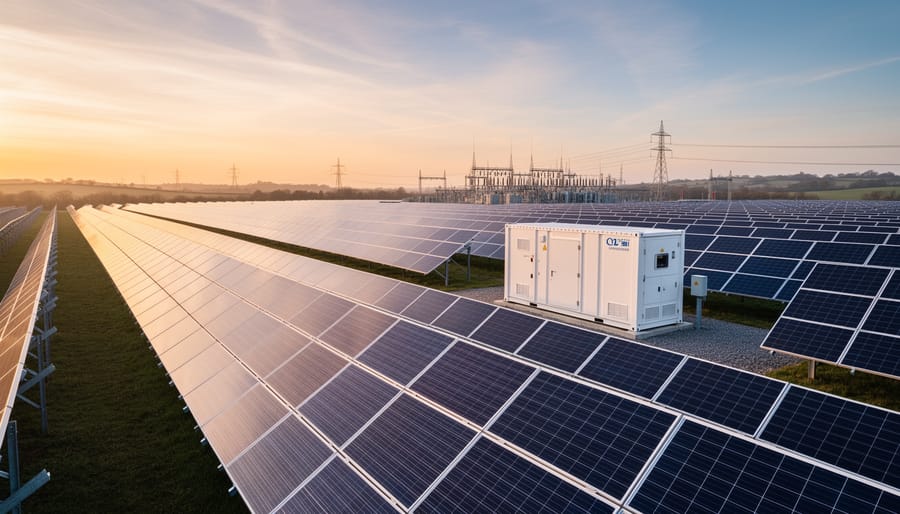
Solar United Kingdom advocates for hybrid energy installations as a pragmatic solution to land scarcity and grid efficiency challenges facing utility-scale projects. The organization has championed co-locating solar arrays with battery energy storage systems, enabling sites to store excess generation during peak sunlight hours and discharge power when demand spikes or renewable output drops. This pairing improves grid stability and makes project economics more attractive by capturing multiple revenue streams, from wholesale market arbitrage to frequency response services.
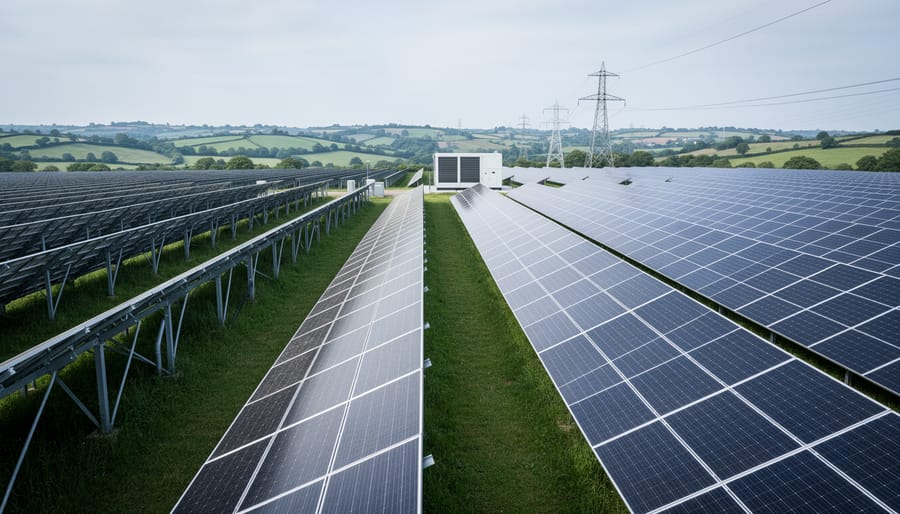
Beyond storage, the network promotes agrivoltaics, positioning panels high enough to allow farming underneath or between rows. Sheep grazing beneath solar farms has gained traction across England and Wales, turning dual-use sites into productive agricultural land while maintaining clean energy output. Solar United Kingdom has highlighted pilot projects where crop cultivation continues alongside power generation, demonstrating that renewable infrastructure need not compete with food production.
Wind-solar hybrids remain a more complex proposition. Combining both technologies on a single site can balance seasonal generation patterns, with wind typically stronger in winter when solar output wanes. However, planning approval for such hybrid schemes requires careful navigation of local regulations and grid connection capacity. Solar United Kingdom has worked to showcase successful examples where developers secured consent for mixed renewable portfolios, arguing these configurations deliver more consistent annual generation and better land utilization than single-technology projects. The organization frames hybrid approaches as essential to unlocking constrained sites and accelerating Britain’s renewable capacity growth.
Challenges and Opportunities Ahead
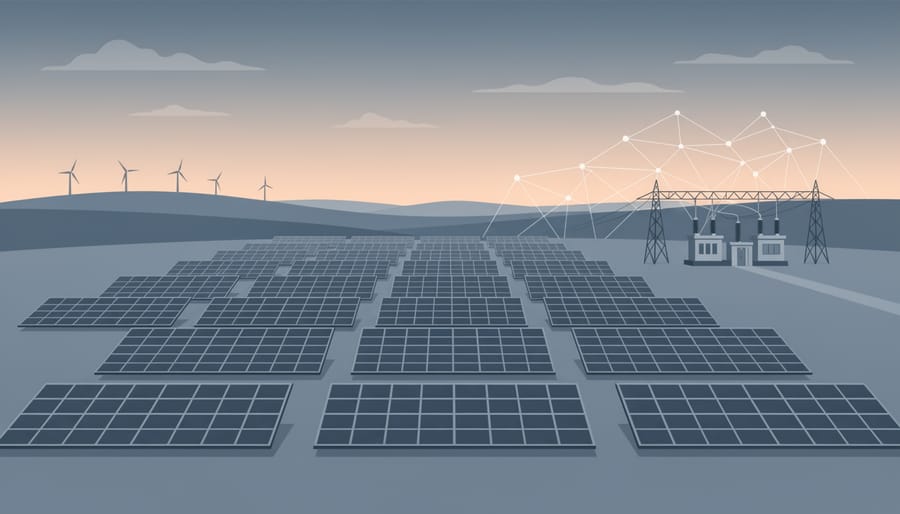
The UK utility-scale solar sector stands at an inflection point where persistent structural challenges meet unprecedented market opportunities. Solar United Kingdom must help the industry navigate planning bottlenecks that routinely stretch project timelines by 18 to 36 months, as local authorities lack both resources and consistent frameworks for assessing large solar applications. Grid capacity constraints compound these delays, connection queues now exceed 400 GW of proposed renewable capacity, with solar projects facing wait times of five to ten years in constrained network areas. These infrastructure limitations fundamentally shape project viability and site selection, forcing developers to prioritize locations with existing capacity or accept prolonged development cycles.
Financing structures present a third major obstacle. Without government-backed contracts-for-difference available to most projects, developers must secure merchant revenue exposure or negotiate corporate power purchase agreements at competitive rates. This shift demands sophisticated risk management and creditworthy offtake partners, raising barriers for smaller players while rewarding those with deep industry relationships and financial engineering capabilities. Land acquisition costs and community acceptance issues further complicate project economics, particularly in densely populated regions where agricultural interests and visual impact concerns generate organized opposition.
Pros
- Falling technology costs make subsidy-free projects commercially viable across most UK regions.
- Corporate demand for renewable PPAs creates stable long-term revenue opportunities outside government schemes.
- Co-location with battery storage improves grid value and project returns through arbitrage and services revenue.
- Planning reform initiatives and national policy statements signal governmental support for streamlined approvals.
Cons
- Grid connection delays of five-plus years prevent many viable projects from reaching construction.
- Inconsistent local planning decisions create unpredictable approval timelines and outcomes.
- Merchant price exposure introduces revenue volatility that complicates project financing without corporate PPAs.
- Land competition from agriculture and development drives up site costs in prime solar regions.
Yet these challenges exist alongside transformative opportunities that Solar United Kingdom is uniquely positioned to help the sector capitalize on. The subsidy-free development model, once considered risky, now represents the mainstream path forward as solar levelized costs drop below £40 per MWh for well-sited projects. Corporate power purchase agreements have emerged as the dominant revenue structure, with major energy users seeking 10 to 25-year contracts to hedge electricity costs and meet net-zero commitments. This corporate demand creates stable, bankable cash flows that rival historical subsidy mechanisms while aligning developers directly with end-user needs.
The maturation of co-located battery storage presents another significant opportunity with direct energy landscape impact. Hybrid projects combining solar generation with 1 to 4-hour storage systems optimize land use, share grid infrastructure costs, and provide flexibility services that command premium revenues during evening peak demand periods. Agricultural co-location models, particularly sheep grazing beneath elevated panels, address land-use concerns while generating dual income streams. These innovations transform the value proposition of utility solar from simple energy generation to integrated grid assets capable of delivering multiple revenue streams and system benefits.
Solar United Kingdom has emerged at a pivotal moment for Britain’s energy transition, when utility-scale solar must evolve from a promising component to a foundational pillar of the national grid. The organization’s contributions at the Utility Solar Summit crystallize its dual role: aggregating industry expertise to solve immediate deployment barriers while articulating a long-term vision that extends beyond megawatt targets to systemic transformation.
The breadth of challenges it addresses, grid infrastructure bottlenecks, planning system inefficiencies, financing model innovation, reflects the reality that scaling solar requires coordinated action across technical, regulatory, and commercial domains. No single company or government agency can reshape these interconnected systems alone. Solar United Kingdom’s collaborative platform provides the connective tissue that turns isolated innovations into industry-wide best practices.
What distinguishes this network from previous sector initiatives is its pragmatic focus on implementation rather than advocacy alone. The hybrid project models, grid queue reforms, and land optimization strategies it champions aren’t theoretical proposals but actionable frameworks being tested across operational projects. This translates summit discussions into real infrastructure that will shape Britain’s energy landscape for decades.
The renewable transition’s success ultimately depends on building institutions that can coordinate complexity at scale. Solar United Kingdom represents exactly this kind of infrastructure, not physical, but organizational. As Britain targets net-zero and confronts the realities of electrification, energy security, and climate adaptation, the country will need more than solar panels. It will need the networks, knowledge systems, and collaborative mechanisms that make rapid, reliable deployment possible. Solar United Kingdom’s trajectory suggests it’s building precisely that capacity when Britain needs it most.