Calculate your electric vehicle’s daily energy consumption by multiplying your average miles driven by 0.25-0.40 kWh per mile. A Tesla Model 3, for example, uses approximately 30 kWh to travel 100 miles, meaning a typical 40-mile daily commute requires 12 kWh of electricity. This baseline determines the solar array size needed to offset your charging costs.
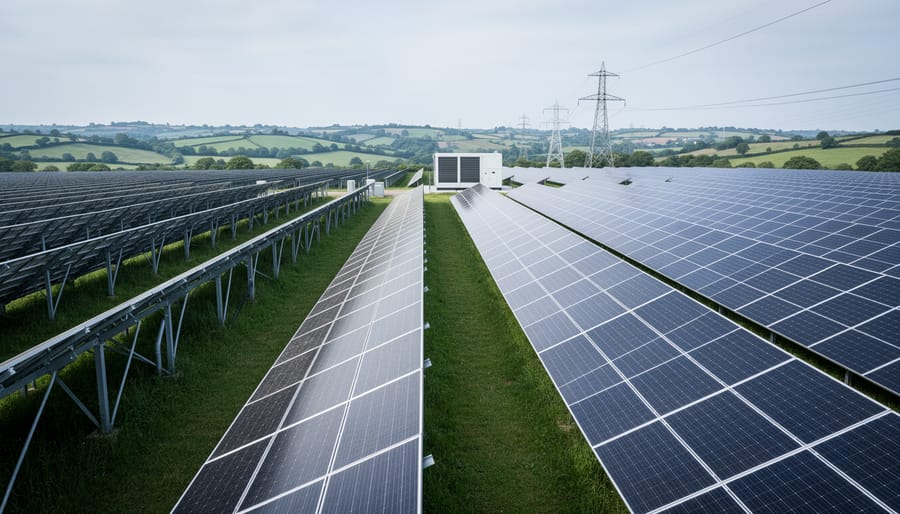
Install a 5-7 kW residential solar system to fully power an average EV’s annual mileage of 12,000 miles. This configuration generates roughly 6,500-9,000 kWh yearly in most regions, sufficient to cover both vehicle charging and reduce household energy bills by 40-60%. Systems of this size typically require 15-20 solar panels with standard 350-400 watt capacity, occupying approximately 300-400 square feet of roof space.
Integrate a Level 2 home charging station with solar panels through net metering arrangements with your utility provider. This approach allows excess solar generation during daylight hours to feed into the grid for credits, which then offset nighttime charging when your vehicle is actually plugged in. Without battery storage, this remains the most cost-effective method for solar-powered EV charging, achieving return on investment within 6-8 years across most markets.
Consider adding a 10-15 kWh home battery system if you want genuine energy independence and the ability to charge directly from stored solar power. While this increases upfront costs by $8,000-12,000, it provides backup power during outages and maximizes self-consumption of generated electricity, eliminating grid dependence and protecting against future rate increases.
The Economics of Solar-Powered EV Charging
Installation Costs vs. Lifetime Savings
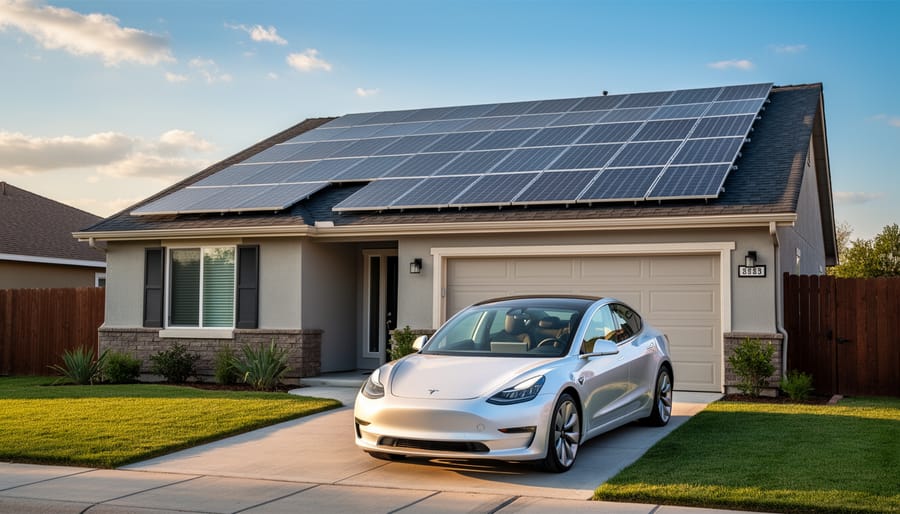
The financial equation for solar-powered EV charging is compelling when examined over time. Initial solar installation costs typically range from $15,000 to $30,000 for a residential system capable of powering both your home and vehicle. For a Tesla Model 3 requiring approximately 3-4 additional kilowatts of capacity, expect to add $8,000 to $12,000 to a standard home solar array.
Against this investment, consider the savings trajectory. The average American driver covers 13,500 miles annually. At typical electricity rates of $0.14 per kWh, charging an EV at home costs roughly $600 yearly. With gasoline vehicles averaging $1,800 in annual fuel expenses at current prices, you’re already saving $1,200 per year with grid-powered EV charging. Switch to solar, and those charging costs effectively drop to zero after payback.
Real-world example: A California homeowner installed a 10kW system for $22,000 after incentives. Powering both home and Tesla Model Y, they eliminated a combined $3,200 in annual electricity and fuel costs. Their payback period: just under seven years. Over the system’s 25-year warranty period, projected savings exceed $65,000.
The mathematics become even more favorable in regions with higher electricity rates or robust solar incentives. In Massachusetts and Hawaii, payback periods can shrink to five years or less, while lifetime savings frequently surpass $100,000 when accounting for rising energy costs.
Government Incentives and Tax Credits
Combining solar panels with electric vehicle charging creates a powerful opportunity to leverage government incentives that significantly reduce upfront costs. In the United States, the Investment Tax Credit allows homeowners to claim 30% of their total solar installation costs through federal tax credits, which applies through 2032. Many states supplement this with additional rebates and net metering programs that credit excess solar generation back to your utility bill. California, New York, and Massachusetts offer particularly generous state-level incentives that can stack with federal benefits.
European nations have embraced solar adoption with varied approaches. Germany’s feed-in tariff system guarantees payments for solar energy fed into the grid, while the UK’s Smart Export Guarantee compensates households for surplus electricity. France recently expanded its solar subsidies, offering up to 1,170 euros for residential installations under 3kW.
Across Asia, innovation meets incentive. Japan provides substantial subsidies for combined solar and battery storage systems, recognizing their value for grid stability. China continues aggressive solar promotion through provincial rebates and simplified permitting processes. Australia’s Small-scale Renewable Energy Scheme creates tradeable certificates that reduce installation costs by approximately 30%.
The Pacific region, particularly New Zealand, offers grants and interest-free loans for solar adoption. Many utilities worldwide now provide special time-of-use rates for EV owners, making solar-charged vehicles even more economical. These financial incentives transform solar EV charging from an aspirational goal into an accessible reality for environmentally conscious drivers globally.
System Sizing: How Many Solar Panels Does Your Tesla Actually Need?
Understanding Your Tesla’s Energy Consumption
Before designing your solar system, it’s essential to understand how much energy your Tesla actually consumes. Each model has distinct efficiency characteristics that directly impact your solar panel requirements.
The Tesla Model 3 stands as the efficiency champion, consuming approximately 250-270 Wh per mile in real-world driving conditions. For an average American driver covering 12,000 miles annually, this translates to roughly 3,000-3,240 kWh per year. The Model Y, slightly larger and heavier, uses about 280-300 Wh per mile, requiring approximately 3,360-3,600 kWh annually for the same mileage.
Moving up the performance ladder, the Model S consumes around 320-350 Wh per mile, totaling 3,840-4,200 kWh yearly. The spacious Model X, with its distinctive falcon-wing doors and larger battery pack, is the thirstiest at 340-370 Wh per mile, demanding 4,080-4,440 kWh annually.
These figures represent typical driving patterns combining highway and city conditions. Your actual consumption will vary based on driving habits, climate conditions, and terrain. Cold weather can reduce efficiency by 20-30% due to battery heating requirements, while aggressive acceleration and high speeds increase energy draw significantly. Understanding these numbers provides the foundation for accurately sizing your solar installation.
Solar Production by Region
Solar panel energy production varies significantly across global markets, directly impacting how effectively you can charge your electric vehicle. In sun-rich regions like California, Arizona, and parts of Australia, residential solar systems typically generate 1,400 to 1,800 kilowatt-hours per kilowatt of installed capacity annually. These areas enjoy 5 to 7 peak sun hours daily, making them ideal for year-round EV charging independence.
European markets present more moderate performance. Germany and the United Kingdom average 900 to 1,100 kWh per kW annually, with peak sun hours ranging from 2.5 to 3.5. Despite lower production, strategic system sizing compensates for reduced sunlight, and many European EV owners successfully achieve 70 to 85 percent solar charging coverage.
Seasonal variations dramatically affect energy availability. Northern hemisphere locations experience 40 to 60 percent lower winter production compared to summer peaks, requiring careful planning for consistent EV charging. Grid-tied systems with net metering help balance seasonal fluctuations, allowing excess summer production to offset winter deficits.
Asia-Pacific regions show diverse patterns. Japan averages 1,100 kWh per kW annually, while tropical locations in Southeast Asia maintain more consistent year-round production. Understanding your region’s solar potential is fundamental to determining the right system size for reliable electric vehicle charging.
The Math: Calculating Your Panel Requirements
Understanding your solar needs begins with calculating panel requirements based on your driving habits. Start by determining your daily mileage. For example, if you drive 40 miles daily in a Tesla Model 3, you’ll need approximately 12 kWh to recharge (the Model 3 averages 0.30 kWh per mile).
Next, factor in your location’s peak sun hours. Arizona residents enjoy roughly 5.5 peak hours daily, while Seattle averages 3.5 hours. Divide your daily energy needs by your peak sun hours: 12 kWh divided by 5.5 hours equals 2.18 kW of solar capacity needed.
Since modern panels produce 350-400 watts each, you’ll need 6-7 panels for this Arizona scenario (2,180 watts divided by 350 watts per panel). Seattle drivers would require 9-10 panels due to reduced sunlight.
Remember to add a 25 percent buffer for system inefficiencies, weather variability, and seasonal changes. This practical approach ensures your system meets real-world demands while accounting for regional differences that significantly impact solar performance globally.
Integration Options: From Grid-Tied to Fully Off-Grid
Grid-Tied Systems with Net Metering
Grid-tied systems with net metering represent the most popular configuration for solar-powered EV charging, combining simplicity with economic benefits. In this setup, your solar array connects directly to the utility grid, allowing bidirectional energy flow. During peak sunlight hours when your panels produce more electricity than your home and vehicle consume, the excess energy feeds back to the grid, spinning your meter backward and earning you credits.
Net metering policies vary significantly across regions. In states like California and New Jersey, homeowners receive retail rate credits for exported energy, maximizing savings. European countries including Germany and Spain have implemented feed-in tariffs with varying compensation structures, while Australia’s net metering programs differ by state and utility provider.
The primary advantage is flexibility. You don’t need battery storage since the grid acts as your virtual battery, supplying power when solar production dips. This significantly reduces upfront costs compared to off-grid systems. However, limitations exist. Some utilities cap net metering benefits or charge connection fees. Additionally, during grid outages, standard grid-tied systems without battery backup cannot power your home or charge your vehicle, even with functioning solar panels.
Adding Home Battery Storage (Powerwall Integration)
Integrating home battery storage systems like the Tesla Powerwall fundamentally transforms how solar energy powers your electric vehicle. These systems capture excess solar generation during peak sunlight hours and store it for later use, effectively extending your solar charging capabilities into evenings and cloudy days.
A typical Powerwall unit stores 13.5 kWh of usable energy, enough to add approximately 50 miles of range to most EVs overnight. By buffering the intermittent nature of solar production, battery storage enables true energy independence, reducing reliance on grid electricity and maximizing your clean energy investment. This becomes particularly valuable in regions with time-of-use electricity rates, where stored solar energy displaces expensive peak-hour grid power.
Multiple Powerwall units can be installed together for households with higher energy demands or multiple vehicles. The system intelligently manages energy flow, prioritizing home consumption, EV charging, and grid export based on your preferences. During power outages, battery storage ensures critical loads and vehicle charging continue uninterrupted, providing both environmental and practical benefits that enhance the overall value proposition of residential solar installations.

Direct Solar-to-Vehicle Charging
Direct solar-to-vehicle charging is transforming from concept to reality, offering electric vehicle owners unprecedented energy independence. Several manufacturers now produce dedicated solar charging systems that connect directly to your EV, bypassing home electrical infrastructure entirely. These solutions range from portable solar blankets generating 200-400 watts—ideal for emergency charging or remote adventures—to permanent carport installations delivering 5-10 kilowatts directly to your vehicle’s battery.
Companies like Paired Power and Beam Global have pioneered standalone solar charging stations with integrated battery storage, eliminating installation complexity and grid dependence. These systems prove particularly valuable in locations where traditional electrical upgrades prove costly or impractical. Meanwhile, bidirectional charging technology enables your EV to serve as mobile energy storage, creating a dynamic solar-vehicle ecosystem. While most current solutions still require grid connection for optimal performance, emerging innovations in vehicle-integrated photovoltaics and ultra-efficient panels promise truly autonomous charging capabilities within the next decade, making solar-powered transportation more accessible across diverse geographic and economic contexts worldwide.
Real-World Case Studies: Tesla Owners Living on Solar Power
Real-world Tesla owners are proving that solar-powered electric vehicle charging isn’t just theoretical—it’s happening successfully across the globe. Their experiences offer valuable insights for anyone considering a similar setup.
In California’s Bay Area, software engineer Marcus Chen installed a 9.5 kW solar array in 2021 specifically to power his Tesla Model 3. Over two years of detailed tracking, his system has generated 14,200 kWh of electricity, covering approximately 42,000 miles of driving. “The math worked out better than I expected,” Chen reports. “My panels produce about 40 kWh daily during peak months, and my Model 3 uses roughly 25 kWh for my 80-mile commute. The surplus powers our home, and we’ve eliminated our electricity bill completely.”
Across the Atlantic, German environmental consultant Anna Hoffman took a different approach. Her 7.2 kW rooftop system in Munich, combined with a 13.5 kWh home battery, provides charging for both her Tesla Model Y and her husband’s e-bike. Despite Germany’s less consistent sunshine compared to California, Hoffman achieves 85 percent solar coverage annually. “Winter months require some grid supplementation, but from April through September, we’re entirely solar-powered,” she explains. Her system paid for itself in seven years through combined savings on electricity and fuel costs.
In Australia’s Queensland region, retired teacher David Reynolds epitomizes solar charging success. His expansive 12 kW system generates excess electricity that he sells back to the grid, effectively making his Tesla charging cost-negative. “I’m driving for free and earning credits,” Reynolds notes. Over three years, his net metering arrangement has generated $2,400 in credits while powering 55,000 kilometers of emission-free driving.
These diverse examples share common threads: careful system sizing, strategic battery storage implementation, and realistic expectations about seasonal variations. Each owner emphasizes that success requires understanding local solar conditions and consumption patterns. Their collective experience demonstrates that with proper planning, solar-powered Tesla ownership delivers both environmental benefits and substantial long-term financial returns, regardless of geographic location.
Installation Considerations and Best Practices
Roof Assessment and Optimal Panel Placement
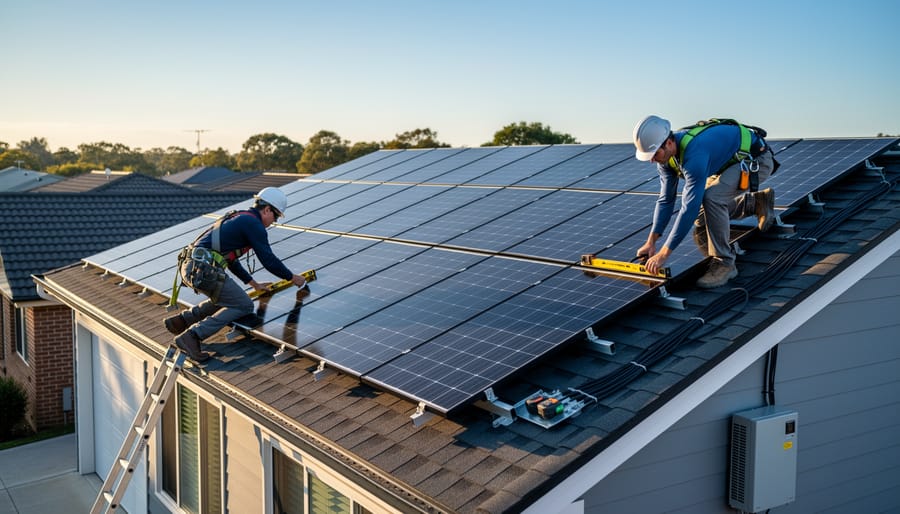
Before installing solar panels to power your electric vehicle, a thorough roof assessment is essential for optimizing system performance and longevity. Start by evaluating your roof’s structural capacity—solar arrays typically add 3-4 pounds per square foot, requiring professional inspection to confirm adequate load-bearing strength, particularly for older homes or those in regions with heavy snow accumulation.
Roof orientation significantly impacts energy generation. In the Northern Hemisphere, south-facing installations capture maximum sunlight, though southeast and southwest orientations can still achieve 85-95% efficiency. For optimal results, aim for a roof pitch between 15-40 degrees, which naturally sheds debris while maximizing solar exposure throughout the year.
Shading analysis is critical yet often overlooked. Even partial shading from trees, chimneys, or neighboring structures can reduce system output by 20-40%. Advanced tools like solar pathfinders or drone-based assessments now provide precise shade mapping across seasons, helping installers position panels strategically or recommend microinverters that minimize shading losses.
Finally, consider roof age and material. Asphalt shingle roofs nearing replacement present an opportunity to coordinate installation, avoiding costly panel removal later. Metal and tile roofs generally offer excellent longevity and mounting options, making them increasingly popular choices for long-term solar investments supporting electric vehicle charging needs.
Selecting the Right Equipment and Installers
Choosing the right equipment starts with understanding your specific energy needs and local conditions. Premium monocrystalline solar panels from manufacturers like LG, SunPower, or Q Cells typically offer 20-25% efficiency rates, making them ideal for residential EV charging applications where roof space may be limited. In Europe and Asia, brands such as LONGi and JA Solar provide excellent value with strong warranties. Your inverter selection matters equally—consider string inverters for straightforward installations or microinverters for roofs with shading issues or complex layouts.
Working with certified installation professionals ensures your system meets local electrical codes and maximizes performance. Look for installers with NABCEP certification in the US, MCS accreditation in the UK, or equivalent credentials in your region. Request multiple quotes and verify they have specific experience integrating solar systems with EV charging infrastructure. Quality installers will conduct thorough site assessments, provide detailed energy production estimates, and offer comprehensive warranties covering both equipment and workmanship. In markets like Australia and California, where solar adoption is mature, installer networks are well-established, while emerging markets may require more diligent vetting of credentials and references.
Emerging Innovations in Solar EV Charging
The convergence of solar technology and electric vehicle infrastructure is accelerating at an unprecedented pace, driven by breakthroughs that promise to reshape how we think about energy independence and sustainable transportation.
At the forefront of these innovations are perovskite solar cells, which are revolutionizing panel efficiency. Traditional silicon panels typically achieve 18-22% efficiency, but perovskite technology is pushing laboratory results beyond 30%, with tandem configurations combining perovskite and silicon layers reaching even higher conversion rates. These lightweight, flexible cells can be integrated into curved surfaces, opening possibilities for solar canopies and architectural applications previously impractical with rigid panels. Commercial availability is anticipated within the next three to five years, potentially reducing system costs while boosting energy production.
Bidirectional charging technology represents another transformative development. Vehicle-to-grid (V2G) and vehicle-to-home (V2H) capabilities allow electric vehicles to function as mobile energy storage units, feeding power back into your home or the electrical grid during peak demand periods. This bidirectional flow creates a symbiotic relationship between your solar array and EV, enabling you to store excess solar generation in your vehicle’s battery and discharge it during evening hours or power outages. Several automakers, including Ford with its F-150 Lightning and Hyundai with select Ioniq models, are already incorporating this technology, with broader adoption expected across the industry.
Smart energy management systems powered by artificial intelligence are optimizing energy flows with remarkable precision. These platforms analyze weather forecasts, electricity rates, driving patterns, and household consumption to automatically determine optimal charging schedules and energy routing decisions. They can prioritize solar charging during surplus production, defer grid charging until off-peak rates apply, or even participate in demand response programs that compensate homeowners for contributing stored energy during grid stress events.
These innovations collectively point toward a future where solar-powered EV charging evolves from a standalone sustainability measure into an integrated ecosystem that enhances grid resilience, reduces energy costs, and accelerates the transition to renewable transportation on a global scale.
The convergence of solar energy and electric vehicle technology represents more than a practical solution to rising fuel costs—it embodies a fundamental shift toward truly sustainable transportation. By pairing solar panels with your electric vehicle, particularly Tesla models designed for this integration, you create a closed-loop energy ecosystem that dramatically reduces carbon emissions while delivering substantial long-term financial returns. The initial investment, though significant, typically achieves payback within 5-8 years, after which your vehicle essentially runs on free, clean energy for decades.
The environmental mathematics are compelling: a typical solar-powered Tesla eliminates approximately 4-6 tons of CO2 emissions annually compared to conventional vehicles, while also reducing strain on electrical grids during peak demand periods. As battery storage technology advances and solar panel efficiency continues climbing toward 30% and beyond, these systems become increasingly viable for households worldwide, regardless of regional climate variations.
The future promises even greater integration. Vehicle-to-grid capabilities, bi-directional charging, and AI-optimized energy management systems are transforming electric cars from simple consumers into dynamic participants in home energy ecosystems. Countries across North America, Europe, and Asia are accelerating renewable energy adoption through enhanced incentives and streamlined installation processes.
The path forward is clear: sustainable mobility is no longer aspirational but achievable today. Whether you begin with solar panels, an electric vehicle, or both simultaneously, each step reduces your environmental footprint while building energy independence. The technology has matured, the economics favor action, and the environmental imperative demands it. The question isn’t whether to transition, but when you’ll start.