A solar farm is a large-scale installation of photovoltaic panels, built on open land or water, that converts sunlight into electricity and feeds it directly into the power grid. Think of it as a power plant with no smokestack, no fuel deliveries, and a fuel source that arrives free every morning.
That simple idea is reshaping energy systems on every continent. From the deserts of the American Southwest to rooftops-turned-fields across Europe, and from fast-growing markets in Asia to island grids in the Pacific, utility-scale solar now delivers some of the lowest-cost new electricity available. Cleaner air, steadier long-term energy prices, local jobs, and reduced carbon emissions are the headline gains. Less obvious is the growing role of solar agriculture, where sheep graze beneath panels, pollinator meadows bloom between rows, and crops grow in their shade, so the same acre produces both power and food.
This article breaks down how solar farms work, the main types in use today, and the practical benefits they bring to communities, businesses, and farmland alike. If you want to understand why so much of the world is betting on this technology, and what’s coming next, start here.
What a Solar Farm Means: A Plain-Language Definition
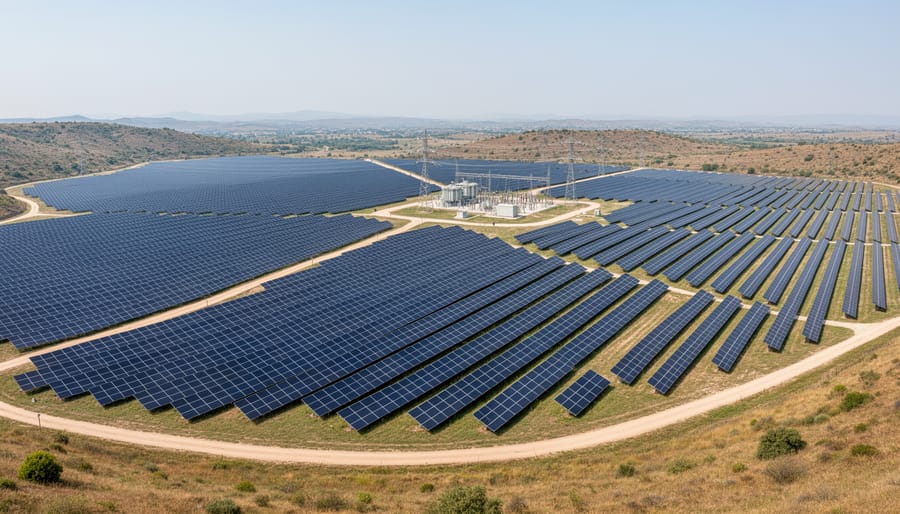
A solar farm, sometimes called a solar park or utility-scale solar, is a large field of photovoltaic panels built to produce electricity at volume. Instead of powering a single home or business, it feeds that power into the electric grid or sends it to a nearby group of customers. Think of it as a power plant whose fuel happens to be sunlight.
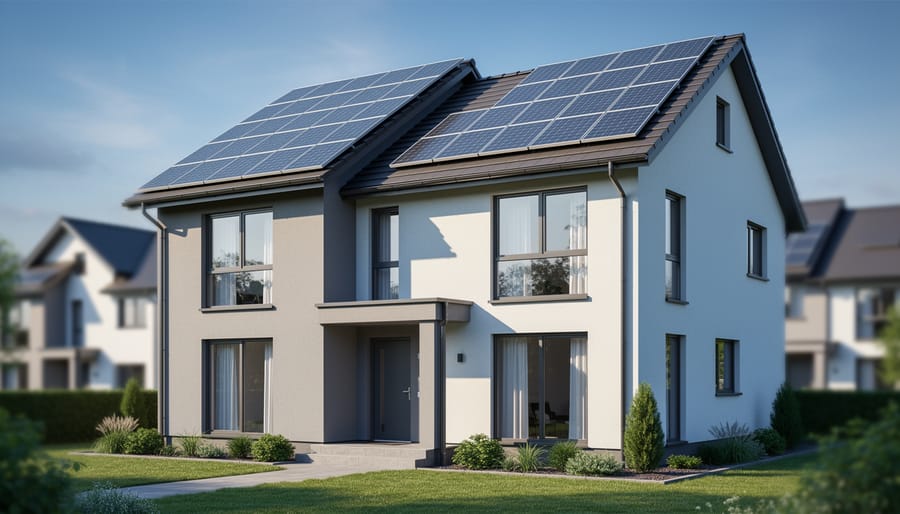
The easiest way to see the difference is to compare it with rooftop solar. Panels on a roof are sized to cover one building’s needs, and the owner usually uses most of the output on site. A solar farm is sized for the grid, with thousands of panels working together on open ground.
A few terms come up again and again in this conversation:
- Photovoltaic (PV) panel
- A panel made of cells that convert sunlight directly into electricity, with no moving parts.
- Megawatt (MW)
- A unit of power equal to one million watts, commonly used to describe how large a solar farm is.
- Capacity factor
- The share of its maximum possible output that a solar farm actually delivers over a year, which reflects sunshine and system design.
- Agrivoltaics
- The practice of using the same land for both solar power and agriculture, such as crops or grazing.
Scale matters because bigger projects spread costs across more panels. Buying equipment in bulk, sharing one grid connection, and managing one site all push the price of each unit of electricity down. A single large farm can also supply meaningful power to a regional grid, something scattered rooftops alone rarely achieve.
That scale comes with a trade-off: solar farms need space. Land use sits at the center of the debate, and it is exactly why ideas that let energy and farming share the same ground are drawing so much attention.
How Solar Farms Turn Sunlight Into Usable Power
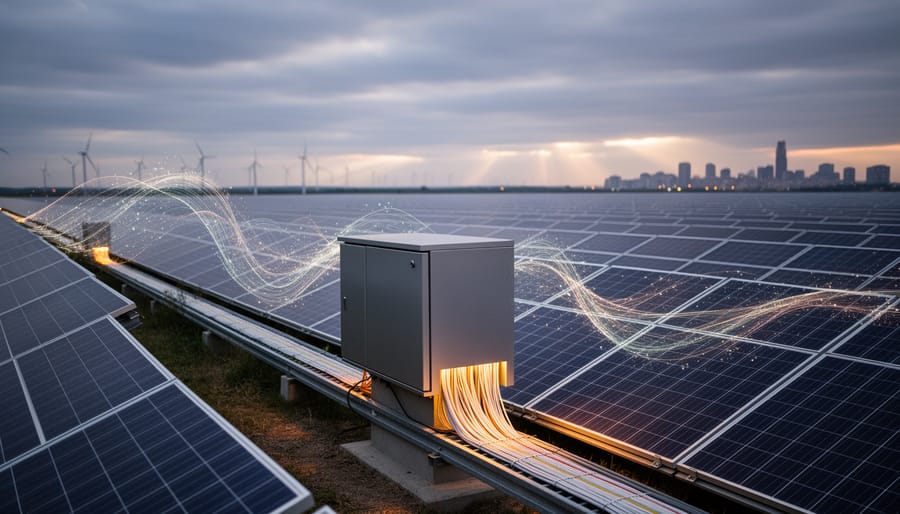
Follow a single beam of sunlight as it lands on a solar farm, and the whole process makes sense. It starts when light strikes the photovoltaic cells inside each panel. These cells are made from semiconductor material, usually silicon, and when photons hit them, electrons break loose and begin to move. That flow is direct current, or DC, the raw electricity of a solar farm.
But DC isn’t what your lights and appliances run on. So the current travels through cabling to inverters, which convert it into alternating current, or AC, the standard form used across power networks. Think of the inverter as a translator, turning the panels’ language into one the grid understands.
Next comes the transformer. It steps the voltage up so electricity can travel long distances with minimal loss. From there, power moves through the site’s grid connection and out to homes, businesses, and factories, or it’s directed into batteries to be stored for the evening peak.
Innovation keeps improving each step. Tracking systems tilt panels to follow the sun from sunrise to sunset, capturing more light than fixed mounts. Bifacial panels collect sunlight on both sides, picking up the glow reflected off the ground below. Both approaches squeeze more energy from the same footprint, which matters when land is valuable.
Because every component is a distinct, adjustable building block, designers can change panel height, spacing, and orientation to suit a site. That flexibility opens the door to sharing the land with crops and livestock.
Types of Solar Farms, From Ground-Mount Arrays to Agrivoltaic Sites
Not every solar farm looks like the endless blue rows people picture. The differences come down to how panels are mounted, what they sit on, and what else shares the site. Choosing among them is really a question of land, climate, and what the local grid needs.
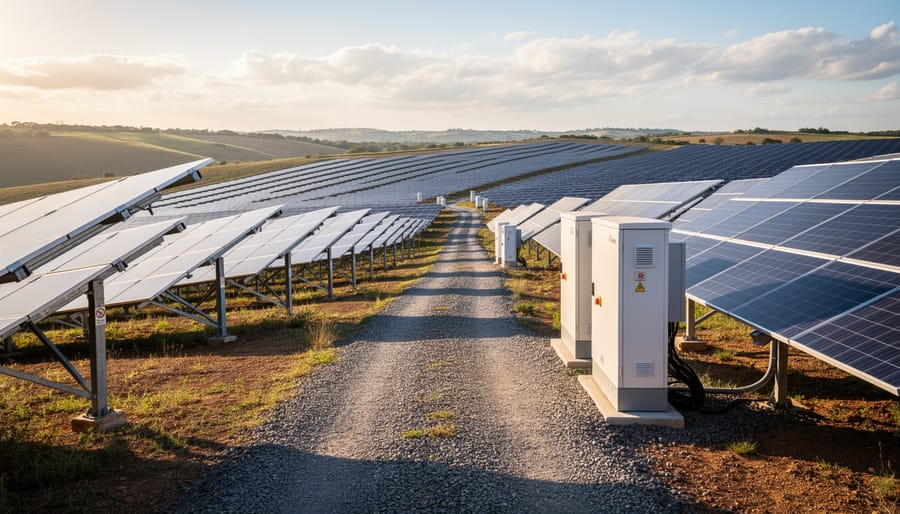
The most common design is the conventional ground-mounted utility-scale farm. Panels sit on fixed-tilt frames or on single-axis trackers that follow the sun from east to west, squeezing out extra output across the day. Trackers cost more upfront but often pay off in sunny regions such as the American Southwest, Spain, and Australia. Panel choice matters too: bifacial modules, which catch reflected light on their rear side, are increasingly popular over bright ground.
Beyond that standard layout, several variations have taken hold worldwide:
- Community solar: a shared array whose output is split among local subscribers, widely used in US states and parts of Europe to open solar to renters and homeowners without suitable roofs.
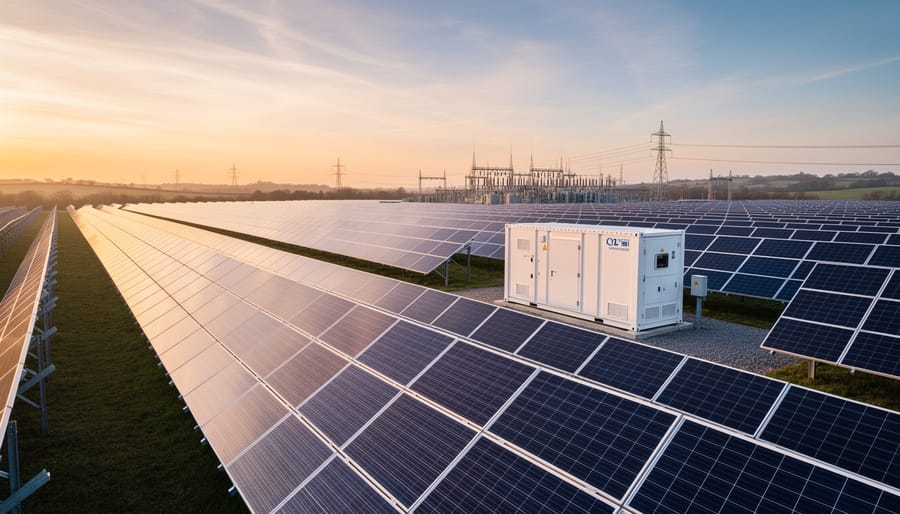
- Solar plus battery storage: panels paired with batteries that hold midday power for the evening peak, now common in California, Australia, and across Europe’s grid-balancing projects.
- Floating solar: arrays anchored on reservoirs, ponds, and irrigation lakes, which save land and can reduce evaporation, with big deployments in Japan, South Korea, India, and China.
- Agrivoltaic (dual-use) installations: raised or widely spaced panels that let crops, grazing animals, or pollinator habitat share the ground, with pilots in France, Germany, Italy, the US, and Japan.
Each type reflects a different answer to the same challenge. Floating systems suit countries where land is scarce and water bodies are plentiful. Storage-equipped farms help grids that already have a lot of solar absorb it smoothly. Agrivoltaic sites typically use higher mounting structures and carefully tuned panel spacing so that tractors, livestock, and sunlight-hungry plants all have room to work.
Component choices tie it all together. Fixed versus tracking mounts, standard versus bifacial panels, and the presence or absence of batteries shape a farm’s cost, output profile, and footprint. That flexibility is a big part of why solar can adapt to so many landscapes and communities.
Core Benefits of Solar Farms for Energy and the Environment
Cleaner, More Affordable Power at Scale
Scale changes the math. When developers build hundreds of megawatts in one place, they buy panels, mounting hardware, and inverters in bulk, share grid connections, and spread engineering costs across far more output. That’s a big reason declining solar PV costs have made solar one of the most competitive sources of new electricity in many regions.
Better technology adds to the savings. Higher-efficiency panels, smarter tracking systems, and improved manufacturing mean each acre produces more power for less money.
For governments and grid operators, utility-scale solar offers a fast, predictable way to add clean capacity and hit national targets. It also helps explain why expanding solar markets keep drawing new investment worldwide.
Local Economic and Community Value
Solar farms put money and work into the communities that host them. Landowners often receive steady lease payments over a project’s life, a predictable income that can help keep land in the family. Construction brings short-term jobs for electricians, equipment operators, and site crews, while ongoing maintenance supports technicians and vegetation managers close to home.
Local governments benefit too. Property or project-based tax revenue can fund schools, roads, and emergency services without raising rates for residents. Many regions also pair these gains with community solar programs, which let renters, apartment dwellers, and households without suitable roofs subscribe to a share of a nearby array and receive credits on their bills.
As projects spread, communities also gain a stake in future grid resilience since locally generated power can reduce strain on distant, centralized plants.
Solar Agriculture Benefits: How Farms and Solar Share the Same Land
Added Income and Resilience for Farmers
Farming income can swing hard from one season to the next. A drought, a late frost, or a sudden drop in commodity prices can turn a profitable year into a difficult one. Solar offers a counterweight: a steady, predictable revenue stream that doesn’t depend on rainfall or market sentiment.
Many landowners host a solar farm through a long-term lease, often spanning two or three decades, with payments that arrive regardless of how the harvest turns out. Others install smaller arrays to power irrigation pumps, grain dryers, or barns, cutting their own electricity bills and shielding themselves from rising utility rates.
Either way, the added income can cover loan payments, fund equipment upgrades, or simply provide breathing room in a tough year. Just as important, it can make the difference between selling the land and keeping it in the family. For many agricultural households, solar becomes a quiet financial anchor that helps the farm endure.
Crops, Livestock, and Pollinators Under the Panels
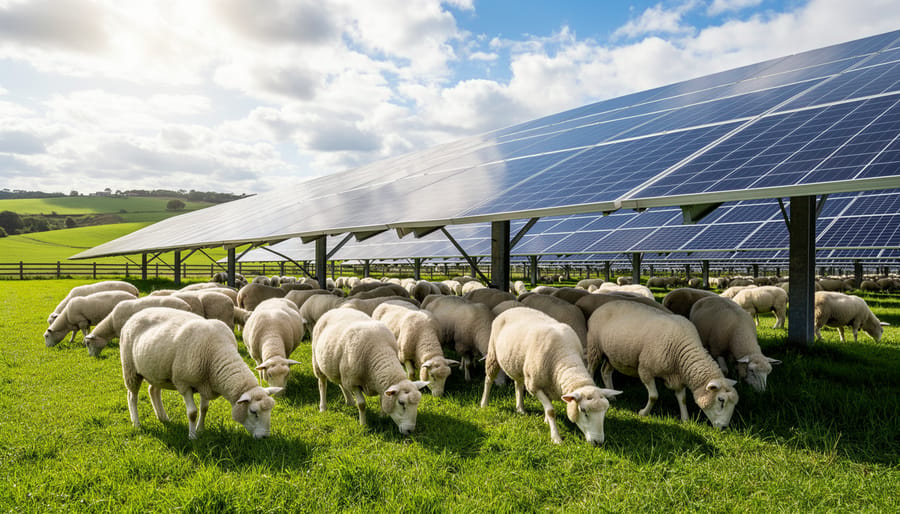
Under the right conditions, the space beneath and between solar panels can do real agricultural work. Shade-tolerant crops such as leafy greens, herbs, and some root vegetables often do well in the partial shade that arrays provide, and growers are also testing berries and certain vine crops. Raising the panels or spacing the rows wider leaves room for light and for farm equipment to pass through.
Livestock fit in naturally. Sheep are the most common choice, grazing the vegetation so crews don’t have to mow, while the animals gain shade on hot days. Smaller flocks and poultry are being trialed in some regions too.
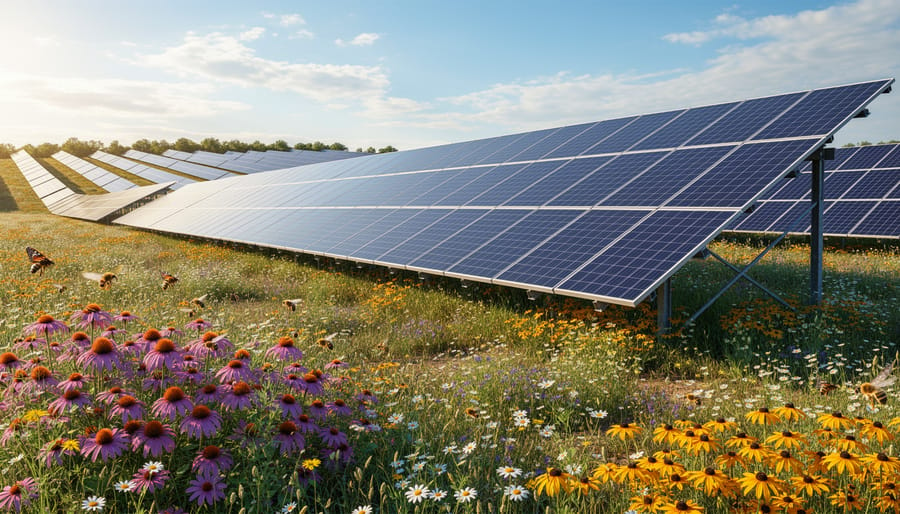
Many sites also plant native wildflowers and grasses to create pollinator habitat, which can support bees and other beneficial insects nearby.
Results vary by crop, climate, and panel design, and researchers around the world are still refining which combinations work best.
Water, Soil, and Microclimate Effects
Panels change the conditions beneath them in ways that can help growing land. Partial shade cuts the amount of direct sun hitting the ground, which can slow evaporation from the soil surface. In hot, dry regions, that may mean moisture lingers longer between irrigations. Shade can also take the edge off midday heat, easing stress on plants and animals that struggle in intense sun.
Soil benefits from what grows beneath the arrays. Permanent ground cover, such as grasses or native wildflowers, protects bare earth from erosion, builds organic matter over time, and gives soil microbes a steady home. Compared with soil left exposed or tilled repeatedly, that living cover can improve structure and water absorption.
Results are not uniform, though. The effect depends on climate, panel height and spacing, crop choice, and how the site is managed. A setup that helps a leafy crop in a desert may not suit a sun-loving grain in a humid region, which is why ongoing field research matters.
How Solar Farms and Agriculture Are Used Together Around the World
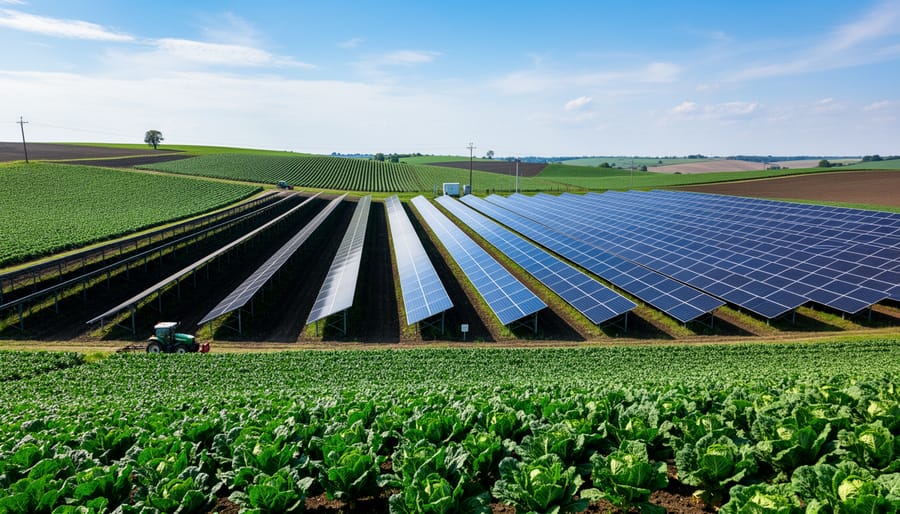
Across the world, farmers and energy developers are finding practical ways to put the same acreage to work twice. The details differ by region, but the underlying idea stays consistent: generate power overhead while keeping the land productive below.
In the United States, dual-use sites often pair solar arrays with sheep grazing or pollinator-friendly ground cover. Sheep keep vegetation in check without mowing, which cuts maintenance costs, while native wildflowers beneath the panels support bees and other beneficial insects. Some Midwestern and Southwestern projects also test shade-tolerant vegetables and forage crops between taller, widely spaced rows.
Europe has become a proving ground for higher-value crops. Vineyard and orchard pilots in countries with long growing traditions mount panels on raised structures, sometimes with adjustable tilt, so growers can balance sunlight for fruit against electricity output. Researchers there pay close attention to how partial shade affects heat stress and water use during hotter summers.
Across Asia and the Pacific, agrivoltaics takes many forms. Rice paddies, tea plantations, and small vegetable plots sit under elevated panels, and in land-scarce regions, floating solar on irrigation ponds and reservoirs offers another way to share space with aquaculture and water storage. These projects often suit smaller farms, where every hectare has to earn its keep.
Beyond the crop-and-panel pairing, many farms simply use solar as a dependable power source. Common applications include:
– Running irrigation pumps during sunny hours, when water demand is highest
– Powering cold storage so harvests stay fresh longer
– Supplying electricity for barns, greenhouses, and processing equipment
– Charging electric farm vehicles and tools
In remote areas, this on-site generation can reduce reliance on diesel generators and unstable grid connections, making farm operations both cleaner and more predictable.
Common Questions About Solar Farms and Farmland
Readers weighing solar projects near farmland tend to ask the same practical questions. The answers below reflect how most projects are planned and managed, though details vary by region and site.
Do solar farms take farmland out of production?
Conventional solar farms use land that might otherwise grow crops, but the footprint is usually a small share of total farmland in any region. Agrivoltaic designs go further by keeping grazing, crops, or pollinator habitat in use beneath and between the panels.
What happens to the land when a project ends?
Many regions require decommissioning plans, which typically cover removing panels, mounting structures, and equipment. Because the ground is generally not paved over, land can often be returned to farming or other uses afterward.
How do solar farms affect local wildlife?
Effects depend on the site and its management. Projects that plant native ground cover and pollinator-friendly vegetation can create habitat, and careful siting helps avoid sensitive areas.
How long does a typical solar farm operate?
Most are designed to run for roughly 25 to 40 years, and panels often keep producing power at reduced output beyond their original warranty periods. Components such as inverters may be replaced along the way.
For farmers curious about dual-use options, the practical first step is talking with local agricultural extension offices, researchers, and experienced developers. They can help match crops or livestock, panel height, and spacing to your climate and soil. Since agrivoltaics is still evolving, starting with a small pilot or visiting an operating site can offer a clearer picture before committing acreage.
Solar farms prove that clean power can be built at scale, and built quickly. They turn ordinary sunlight into steady electricity for grids, towns, and farms, while costs keep falling and the technology keeps improving. That combination is why utility-scale solar now sits at the center of energy plans from the US to Europe to Asia and the Pacific.
The bigger story may be what happens on the land itself. Agrivoltaic sites show that energy and food production don’t have to compete. Sheep graze beneath panels, shade-tolerant crops thrive in cooler microclimates, and farmers gain a second income stream that helps their land stay in production for the next generation.
Researchers and growers are still learning which crops, panel designs, and climates work best, and that experimentation is where the most exciting progress is happening. Keep an eye on this space. The next few years of agrivoltaic innovation are likely to reshape how we think about both power and farmland.